
Wheel Alignment in Aurora, CO
Backed by our 3-year/33,000-mile warranty
Wheel alignment sounds technical, but the idea is simple: your tires should point where you steer. At Zoom Automotive & Diesel Repair, we measure the angles of each wheel, adjust what can be adjusted and tell you about anything worn that needs a repair first. Drivers from across Aurora bring us cars, SUVs and trucks, and our eight-bay shop on E Girard Ave has room for all of them.
How do you know you need a wheel alignment?
You likely need a wheel alignment when the way your vehicle drives changes. Many drivers feel a pull and just live with it. That costs tire life and wears on the steering parts. A quick wheel alignment check is a small step that protects a much bigger purchase. These are the clues.
- The vehicle pulls to one side
- The steering wheel sits off-center on a straight road
- Your tires wear unevenly
- The vehicle wanders or feels twitchy at highway speed
- You hit a curb or pothole, which can shift the angles
A wheel alignment does not change your tires or your parts. It sets the angles they sit at, so the whole system works together as designed. When the angles are right, the vehicle tracks straight, the tires last longer and the steering feels calm.
Pulling, an off-center wheel and uneven wear tell the story
A steady pull to the right or left means the angles on the two sides do not match. An off-center steering wheel means the front tires point straight while the wheel sits tilted. Uneven wear shows up as a smooth edge on one side of the tire, or sharp feathered ribs across the tread.
Run your hand across the tread. If it feels smooth one way and rough the other, the tire is being dragged sideways as it rolls. That points straight to toe.
A vehicle that fights itself also drags its tires sideways as they roll, which wears them faster. Many owners notice a calmer ride and a quieter cabin after the angles are corrected.
Expert tip
Hold the steering wheel loosely on a flat, straight road. If the vehicle drifts, note which way and tell the technician. It helps us find the cause faster.
What do toe, camber and caster mean in plain English?
Three angles decide how your vehicle tracks, and each one has its own job. Toe has the biggest effect on tire wear, because even a small error scrubs rubber off with every mile. Our alignment machine measures toe and camber at each wheel and caster at the front. Here is what each term means.
How much the front of the tires point in or out, like your feet when you stand.
The tilt of the wheel when viewed from the front, leaning in at the top or out. It changes how the tire sits on the road in a turn.
The angle of the steering pivot as seen from the side. It steadies a vehicle at highway speed and helps the wheel return to center.
After the machine reads the wheels, the technician adjusts caster and camber where your vehicle allows, then sets toe last, because the other adjustments move it. We measure again to confirm the numbers.
Can potholes and curbs knock a vehicle out of line?
Yes. One hard pothole or a scrape on a curb can bend a tie rod or shift an adjustment bolt, and the angles move right away. A pothole hit at speed does more harm than one you roll through slowly. Aurora winters leave plenty of broken pavement around, and spring thaws can leave a few more.
A curb scrape on a tight turn can bend a wheel or a steering arm.
You may not feel it at first. The vehicle may drive fine for weeks while the tires quietly wear. If you hit something hard, it is worth a check, even if nothing feels different.
Expert tip
After any big hit, look at the tire sidewall for a bulge and check that the steering wheel still sits straight. Either one is a reason to come in.
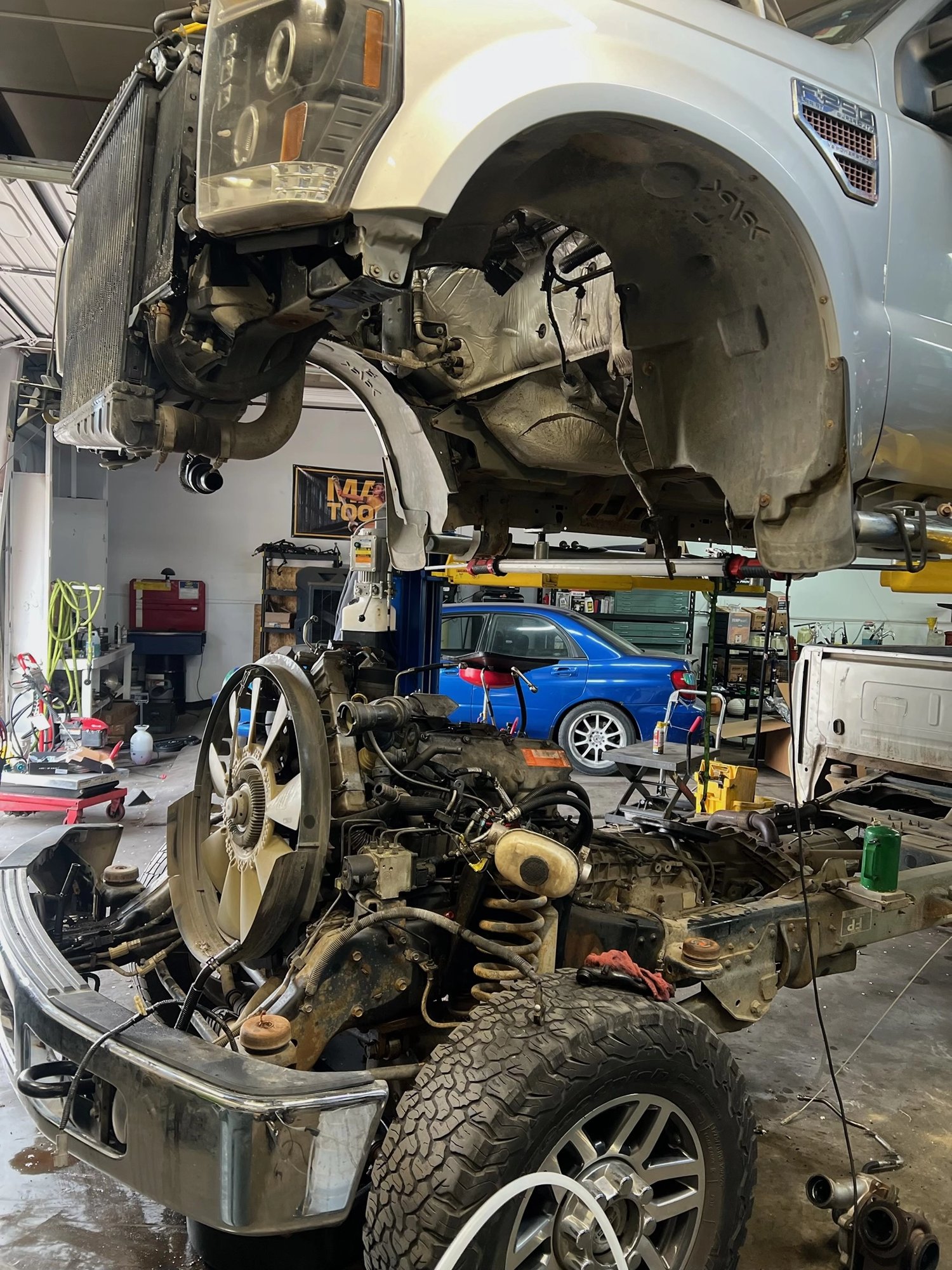
A lifted truck or larger tires change the wheel alignment numbers
Raising a truck or adding larger tires changes the suspension geometry. The angles move away from the factory range, and standard adjustments may run out. Heavier tires and wheels also put more strain on steering parts like tie rods and ball joints.
If your truck has been lifted or fitted with larger tires, tell us when you call so the technician knows what to expect. If the numbers cannot reach the factory range, we explain what we found and why. Leveling kits, new wheels and larger tires should all be followed by an alignment.
Bigger tires also rub differently at full steering lock, and a lifted truck can feel loose at highway speed until the angles are set. A good alignment gives a lifted truck a steadier feel at highway speed.
If you plan to lift a truck or add larger tires, schedule the wheel alignment right after the install, before you put many miles on the new setup.
What does the tech check before aligning?
Before touching an adjustment, the technician checks the parts that hold the angles in place. Worn parts cannot hold an alignment, so a good alignment starts with checking that the parts are tight. A sagging spring changes the angles too, so we look at ride height and tire size. Here is what gets checked.
- Tire pressure and condition
- Tie rods
- Ball joints
- Control arm bushings
- Wheel bearings
If something is worn, you see it in a photo with a plain explanation. Then we repair it first, and measure after.
We also take a short road test before and after, so we feel the pull the way you do and confirm it is gone.
Wheel alignment after suspension or tire work protects the new parts
Replace a shock, strut, control arm or tie rod, and the angles change. Mount a new set of tires, and you want them wearing straight from the first mile. That is why we pair a wheel alignment with suspension and steering work and tire services.
Our work comes with our 3-year/33,000-mile warranty, and you get a clear estimate before anything starts. If a worn part turns up, we explain it and you choose the next step.
A wheel alignment right after the repair keeps the new parts from wearing in a bad position. It also gives you a clean starting point, so any new pull or wear pattern later stands out right away.
Expert tip
Buying tires and want an alignment too? Do both in the same visit, so the new set starts out straight from the first mile.
More auto repair services
Worn parts behind knocks over bumps and a wheel that wanders.
Cool air in August, and a heater and defrost you can count on in January.
We read the whole message behind the light and explain what it means.
Why drivers choose Zoom
A family shop with the details done right
Every repair comes with a clear estimate first, photos of what we find and a warranty that covers the work for 3 years or 33,000 miles.
Schedule your wheel alignment and straighten out your drive
For a straight, steady drive, visit Zoom Automotive & Diesel Repair at 18385 E Girard Ave Suite A, Aurora, CO 80013. We are open 8:00 AM to 5:30 PM, Monday through Friday. Call (303) 736-8889 to schedule a wheel alignment, or contact us.
Many customers add brake work or an oil change to the same visit, and the rest of our car repair services are on hand too.